Living the Questions


“Be patient toward all that is unsolved in your heart and try to love the questions themselves….Perhaps you will then gradually, without noticing it, live along some distant day into the answer.”
Rainer Maria Rilke, Letters to a Young Poet
Treat the questions of young people as invaluable treasure—affirm and nurture them so that students learn to own and to love them.—Natural Circles of Support Guide for Facilitator-Mentors.
In Natural Circles of Support’s small mentoring program for Black students, we try to use questions to help young people reflect on their personal experiences, contemplate their behaviors and actions, and be wise and intentional about their choices. Meaningful questions can serve as a crucible for their personal reflection, growth, and development, help forge identities and give shape to possibilities. If we encourage our students to patiently sit with them, let them settle and season in their minds and in their hearts, good questions can ground, root, and give life to young people.
Sometimes this means encouraging Black students to notice and explore the enduring unspoken questions that already reside in them and find a way to embrace them. These are the questions that come from interior yearnings that will not go away, felt in their bones, and that they cannot shake. These are the yearnings they find hard to name or express but must live with and so must learn to love.
We also journey with young people into new questions through experiences that enlarge their sense of self and the world—their imaginations and possibilities—questions that can help them (re)locate themselves in the world around them.
A little over 10 years ago, I was working in the gazebo that sits on the eastern edge of our backyard. Little more than a tent but for the 10’ by 10’ black metal frame around which the beige netting and curtains hung to the wood chipped ground, and from which the fading khaki top angled up to about 12 feet above ground. It offered a sense of spaciousness as well as cover to me from the sides and to the rear, while in front of me, veiled by mosquito netting, the gazebo opened to the green blooming busyness of our summer garden.
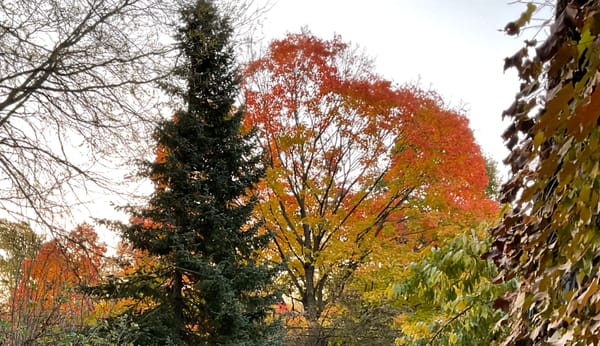
It was around the first week of June and Madison had comfortably settled into the growing season; the fear of frost had finally passed. The lilac was tall and dense with leaves, bending to form a partial tunnel with heavy branches that shaded the sidewalk, reaching down to menace or to greet. On that day, as I sat working in the gazebo, I heard and began to listen to the voices of three African American girls, in late elementary or early middle school judging by their voices, approach the lilacs partially arched over the sidewalk as if reaching for the hostas, prairie grasses, and other plants growing on the other side.
As the girls passed by the lilacs, their pace slowed and their voices grew soft and quiet, as if they did not want the overhanging bush to listen in on their conversation, and then, for a few seconds, they fell silent. I sat unmoving on the hardwood chair, its seat and back curved to fit the shape of my body, as an unseen member of the slowly evolving scene. Though I could not see them, nor they me, my ears opened to the sounds and silences; I sat wondering if our wild hedge might have unintentionally offended. Then, one of the voices unfolded out of the silence, as if testing her thoughts out loud, and pondered,
“Why is it that when I walk through here, I feel like I’m in a jungle…” pausing while silence held her partial question, she then continued with a slightly lower voice, not quite a whisper,
“…and I kinda like it?”
My slow exhalation revealed a tension in me that I did not know I held, while a smile slowly formed on my face, remembering a third grade boy who participated in a school garden project that I led decades earlier in Portland, Oregon.
One day each week, he and his classmates from the nearby Catholic parish school that served many black and brown children in their neighborhood, made their way from the school to the energy demonstration home one block away where I was caretaker for the house and coordinator for the community gardens located across the street.
Each week the students rumbled up the stairwell that stretched from the entry to the third floor greenhouse where they learned to grow starts for their plot at the garden. Each week, they rumbled up the stairs, jostling each other with exuberance, excited to enter the magical space where the roof was made of glass that could be made to open and close, and where, even in winter, the plants grew in the humid, sometimes sultry, air.
One week, as they started to bound up the stairs, I announced that their seeds had sprouted and were starting to grow. Hearing this, the whole herd grew quiet, moved slowly and spoke in whispers, even when, on tippy toes, they peered over the bins that held their seedlings, and voiced wide-eyed exclamations of surprise, awe, and joy.
The students would go on to nurture their seedlings into plants later transplanted into their class plot where they and their families harvested the produce throughout the summer and into fall. But at the end of the school year, this third grade boy whose dark brown face, though faded, is still etched in my memory, gave me a note with his drawing of a seedling in which he thanked for allowing him to participate. In the note, he shared to my unsuspecting joy,
“I’ve always wanted to know how plants grow.”
And in that moment, I found myself suddenly aware of all that each of us might hold in our hearts, minds, and in our bodies, that, like a seed in rich soil, waits for the right conditions of love and care to sprout and to grow.
At Natural Circles, we have seen that young people flourish when nurtured in a way where they can discover new questions (“Why do I like the feeling of being in a jungle?”) or have unvoiced questions answered, (“How do plants grow?”). We believe our best work as mentors and teachers happens when our guidance and lessons help young people discover the questions that they will learn to love and live into, questions that feed their joy and their wonder, questions that will lead them to new ways of being, belonging, and participating in the world around them.