The cycle of life and living
I recently decided to leave Substack and instead post my meditations and articles on Ghost. The following is the last article I posted on Substack prior to closing the account. I wrote it in memory of my mother who passed on Christmas Day, 2021.
“And the end and the beginning were always there…”
T. S. Eliot, The Four Quartets
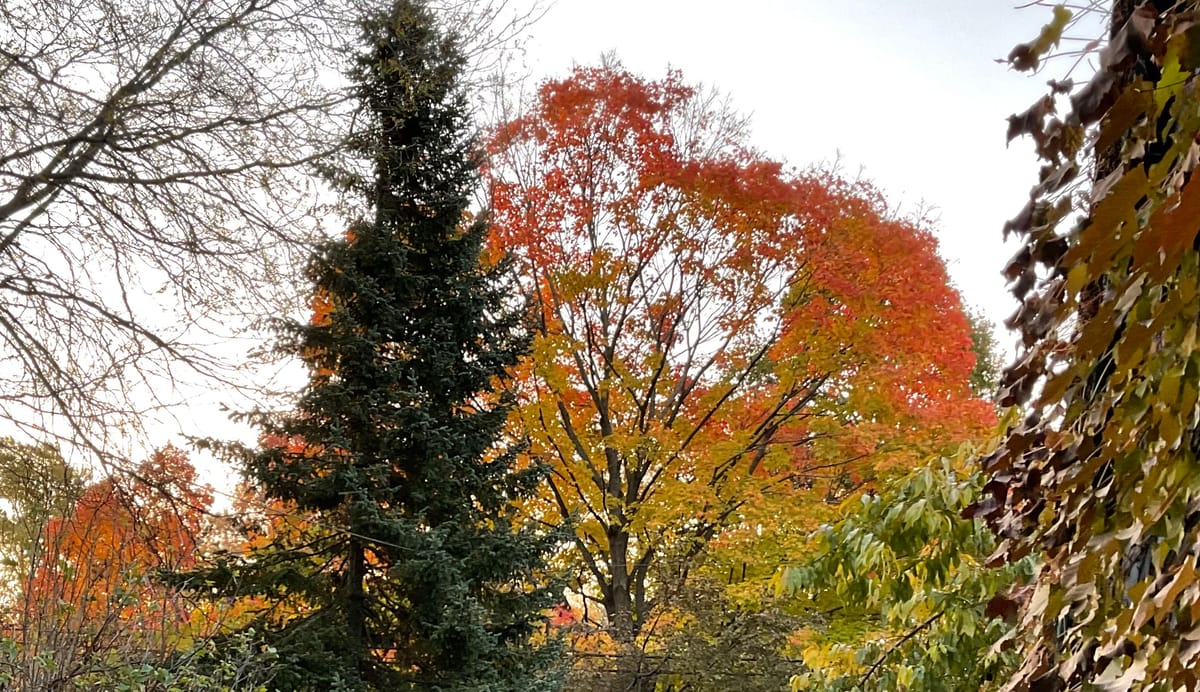
In November 2019, the maple arching high over our front yard in Madison had released the last of its autumn leaves, which fell softly to the ground, helped along by wind, rain, and time. I raked them into damp, pungent piles to later dump onto berms, spread under trees and shrubs, and over the garden beds in our yard where they would continue their long and familiar journey from decay, to root, then back to leaf again. The cycle of our lives and our living.
The world of our family was also beginning a slow but unexpected change, just a few months before a pandemic would change the world. Our family’s small world was loosely knit together by me, my four siblings, and my mother, a widow for nearly 40 years, now living with dementia. With her diagnosis, the patterns of our relationships began to wobble out of their familiar orbits and out of our control.
Most Sundays before my mother’s illness, she and my three sisters gathered at her house in St. Louis, Missouri, to play the trick-taking card game Bid Whist -- a game my sisters had enjoyed since childhood. Now in middle age having lived lives both hard and full, their play was laced with wisecracking humor and a take-no-prisoners speed and brilliance. I could only watch them in awe and at a distance, trying to make sense of the strategies of play coded by body language, cryptic comments, finally revealed by explanations defended at the end of a round. The game offered them a way to stay connected and give space to deep, conflicted emotions expressed in card play and safely left behind on the dining room table.
My brother and I had long ago moved away from the family home. I spent much of my adult life out west in Berkeley, Portland, Eugene, and Davis, before moving to Madison, Wisconsin, with my family of marriage and of choice, nearly twenty years earlier, to be within a day’s drive of my mother.
My brother, the oldest of us, had gone in search of warmer, winterless places, living in Louisville, Houston, and New Orleans before settling down in Pensacola, Florida, a place he described to me as “a place to grow old.”
Now we were all growing old and our mother, nearing 90, needed our help. And we, for the first time in decades, needed one another. Phone calls, texts, and letters unearthed troubling issues and deep concerns about my mother’s care and well-being. Old relationship patterns surfaced in new tensions between us, testing lines of affection, loyalty, and trust. Although my sisters could do much more for my mother than I, her care was too much for them to do alone. I decided to go home to help.
By early spring, I had made several six-hour trips to St. Louis, hoping to bring relief to my sisters. I helped out by purchasing groceries and making small repairs on my mother’s house. I also enjoyed my mother’s company and the stories that rose out of the fog of her dementia when her mind and memory entered old photos with images from earlier in her life.
It was through hearing her stories and seeing my mother daily in her house that I began to notice that when one has lived in a house for a long time -- long enough for generations of relations to have passed through you and with you: children, grandchildren, and various “greats” -- the house grows to fit you, and you it. You give each other shape, as couples who have lived a lifetime together can share similar smiles, wrinkles, and a slow, deliberate gait.
I would also come to learn that when one has lived in a place long enough, roots born of births and beginnings, laughter and worries, and the inescapable ending of things, sprout, spread, and deepen, extending into and out of the complex intermingling of experience and memories that inhabit and give life to a place. The house and my mother were a joining of a life and a place, each made whole by the other. The house and my mother embody memory and together they embody ghosts.
Momma, rounded and bowed with the inevitability of time and age, plods along without her walker and without haste. Her pale blue gown hangs lightly and loosely from frail shoulders and around her brown body. Her feet, adorned in white socks, knowingly take her down the dark and narrow hallway from her room toward the dimly lit kitchen. She hums a familiar hymn, one I would sometimes hear her singing when I was home, (“It is no secret what God can do…”), a sign of her faith and commitment -- her gratitude for what she tells us is the blessing of one more day.
Wearing the hallway’s shadows like a hooded robe, she uses the walls for aid and balance as she makes her way toward the living room. First, she reaches for the wall with her left forearm, braces, balances, then a careful step. Now a slow shift and pivot of hips to the right, extending her right forearm to the other wall -- brace, balance, then step.
When she gets to the door, slightly ajar, leading into the room in which I now stay as a visitor in her house -- the room that was mine in childhood -- she pauses, faintly pushes the door open, lowers and turns her head to peer into the room where I am working.
The dementia that has settled in her brain sometimes jumbles and confuses my mother’s mind, but her eyes remain surprisingly clear. Eyes that knowingly consider and measure. And though the contours of her face morph daily into familiar images of various family members and relations, her eyes are the eyes she has had her whole life. They are the eyes of this house.
“Good mornin,’ Momma,” my voice is soft and slightly hoarse.
“Good morning,” she replies with matriarchal warmth, kindness, and grace. Her simple response briefly awakens ghosts that live in this house and in me -- memories of the same reassuring tones spoken decades earlier through a bathroom door when, as a twelve-year-old boy, I raced from my bedroom into the bathroom and slammed the door, no longer able to bear the sounds of my father’s wrath, his threats and his anger, and the violence he always aimed at my mother, his wife, in her house. Knowing little of fate or forgiveness, with hot tears streaming down my cheeks and a stifled gut-filled anger, I swore, “I’ll never have children!” A moment of silence held the house and the space between us. Stilling the storm of her own emotions, she spoke, her voice low and near to me as she crouched on the other side of the door.
“Jeffrey.” The calming overtones of her voice touched my spirit, held me as if I were in her arms. I wiped the tears from my cheeks; my sobbing subsided. The tightness left my shoulders and chest, my breaths became slow and deep. I heard no sound of my father. I had reason to hope and to live.
Hearing Momma’s simple greeting this morning reminds me who I am at this time in our world, at this time in her life, and in this place that is her house. Though the part of her mind loosely connected to short-term memory does not always recollect where she is, the part that is deep in her and in the house where she has lived for 55 years, knows exactly where she is. Her mind is incarnate in the house. They are joined to one another. And in the presence of this mystery and memory, I am always at home.
I stand in the hallway near my mother’s bedroom door as the hospice nurse completes her daily examination. Her heartbeat is irregular. Her blood pressure is 70/40. Her breathing is slow, deep, and rhythmic; only four breaths per minute. No more fat reserves, no sounds in her bowels but she appears to be comfortable. “Just a few more days,” the nurse says as we all hold my mother with our eyes and our thoughts, knowing that it is true.
“You have my permission to leave, Miss Barbara,” the nurse says quietly, as much to herself as to my mother. Tears cloud our eyes; some fall.
My middle sister, Momma’s caregiver, says to no one in particular that sometimes my mother reaches out, as if for someone. She demonstrates as she says it, her eyes never moving from our mother. We all privately consider what this gesture might mean.
The nurse gathers her things and prepares to leave, turns to hug my sister, tells her that she has done a great job. I return to the chair beside my mother’s bed. I keep repeating to myself, “She’s going home, now; she’s going home.” My mother, long the center of our lives will soon release her hold on us, and we will have to reorder and rearrange ourselves in ways we cannot yet imagine.
It is 5:00 a.m. on December 25. I hear the soft knocking at the door to the room where I have tried to get some sleep.
“Jeffrey?” My sister’s voice is low with a hint of country in it. She calls to me as if she doesn’t want to wake me if I’m still asleep.
“Yes?” I respond evenly, knowing what she has come to tell me.
“I think she’s gone.”
I get up and we go into Momma’s room. We stand together and watch her body for movement. No sound, no breath.
“Normally, I have my TV on, but not last night,” she tells me. “I heard Momma when she began to gurgle with her last breaths and went in to see. Sometimes the universe is on time.”
At 9 a.m. the same day, I take my list of people to call and go for a walk in Forest Park, the city’s largest park and site of the 1904 World’s Fair.
Unusually mild weather holds the stillness of the city. I pause and a silence holds me like cupped hands. I feel my mother’s lingering presence and love. Something between a chorus and cacophony of bird song showers me from high in the forest’s leafless branches.
I try a second and third time to reach Clare on my phone to share with her that Momma has passed so that she can tell our three adult children. No luck.
On my walk in the forest, I come across a self-guided tour along the path that explains the forest’s ecology. I learn that some spring ephemerals arrive early, before the first canopy is formed. They photosynthesize all the energy they will need to live and thrive for the rest of the year, including the energy needed “to flower and release their seed” the way prayer in my mother’s life allowed her to live wholly and deeply through joys and hardships, a life that still aids her children, now released, in our searching to find our way in this world.
Walking through this forest community, I feel a part of its enduring slow dance, the cycle of life, death, and lasting beauty. I come to the end of the loop and find a path that takes me back toward my car, ready to return to mother’s house. Soon, I will make the trip north back to my own home where the now leafless maple in our yard rests in deep winter, guarding the energy it has stored for another year, preparing itself for when it is time to reveal the first buds of spring.